

Choosing an IT solutions partner based only on the lowest monthly cost often leads to more employee downtime than expected. Over time, the money saved on the invoice is lost in hours your staff can’t work.
Picture a Tuesday morning when your email server stalls and twelve employees sit idle for two hours waiting on a fix. No invoice line captures that silence, yet it costs real money.
That gap between what you pay and what you lose is where the real price of business IT solutions hides. A monthly fee can look like a bargain on paper, with a lower rate than competitors quoted and numbers that please whoever reviews the invoice.
Yet the invoice never counts the hours your staff spends refreshing a frozen screen or waiting on hold for a technician. Add those hours up across a team, a week, a quarter, and the lost time can quietly outweigh whatever the cheaper contract saved. Business IT solutions were never just a line item to begin with: they keep systems running, data within reach, and staff able to do their jobs without interruption. Choosing a provider means choosing the reliability your business depends on to keep moving, not just the technology itself.
So the lower bill that first caught your eye deserves a second look, because the true cost of IT support surfaces in how fast your team returns to work once something breaks. If a provider can't deliver that speed, whatever you saved on the contract evaporates in lost hours.

Why downtime costs more than you think
Downtime rarely stays contained to the system that failed. Once files, email, or customer-facing tools go dark, the disruption spreads through the rest of the day, slowing projects and wearing down staff patience as it goes.
Each minute an employee spends waiting on a fix is a minute not spent on the work that actually matters, and multiplied across a team, that idle time compounds fast. For many businesses, the resulting hidden costs end up dwarfing whatever the cheaper IT contract saved on paper.
The trouble is that none of this shows up on a bill, so it's easy to miss until the pattern repeats often enough to notice. Slow support and recurring issues drain resources quietly, which is exactly why the lowest price rarely equals the best value.
The hidden risks of choosing based on price
Picking an IT partner mainly for a low monthly fee postpones the trade-offs rather than removing them. Lower-cost providers often run leaner staff, offer narrower coverage, or respond more slowly, and those gaps stay invisible until something actually breaks.
A provider focused on trimming costs may also skip proactive monitoring or routine updates, and that absence leaves systems more exposed to downtime, security threats, and data loss. The monthly price, in other words, says nothing about the risk quietly building behind it.
In Northern Virginia, where businesses lean on technology just to stay competitive, a slow response can mean a missed opportunity that doesn't come back around. When an IT partner can't keep pace, the team footing that bill does so in lost hours and mounting frustration.

How business IT solutions impact employee productivity
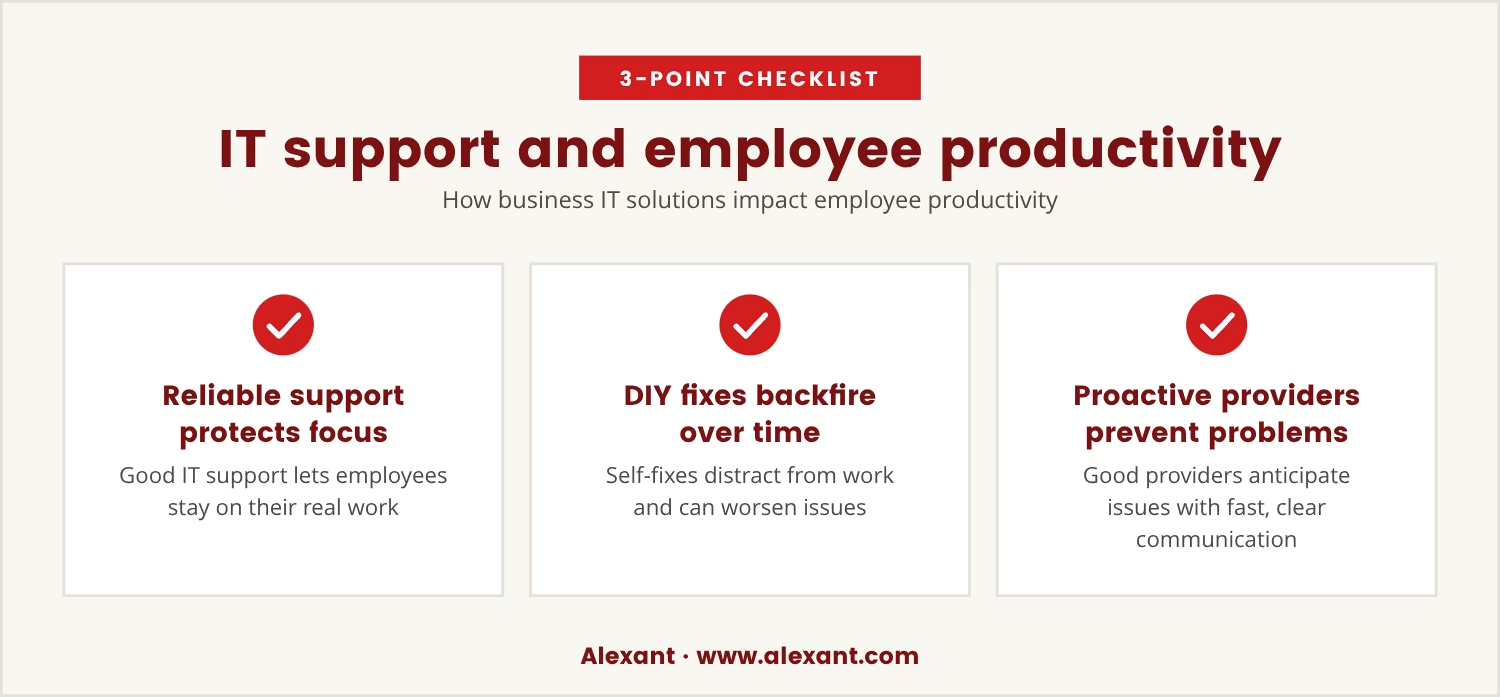
Reliable IT support keeps that productivity intact by letting employees focus on their actual work instead of troubleshooting or waiting on hold. The moment support slows down, though, staff often try to patch problems themselves.
That do-it-yourself fix pulls them away from their real responsibilities and can make the underlying problem worse, and over time, these interruptions chip away at both morale and efficiency.
A provider that understands the business it serves designs solutions to head off problems before they surface, backed by clear communication and fast helpdesk response. That combination marks the real difference between a service that saves money and one that quietly costs more over time.
What really happens when you choose the cheapest provider
It's tempting to assume every IT provider delivers roughly the same service, but price-driven choices tend to play out in a fairly consistent pattern. Here's what that pattern usually looks like:
Response times slow down
Cheaper providers often run with fewer technicians, so requests queue up and wait their turn. An issue that should take minutes to resolve ends up dragging on for hours or days.
Problems recur
Skip proactive monitoring and regular updates, and the same issue tends to resurface again and again. The team ends up fighting the same fire more than once.
Communication breaks down
Lower-cost contracts often skip a dedicated contact or a clear escalation path. When something goes wrong, nobody's quite sure who to call or how soon help will arrive.
Security takes a back seat
Cutting corners on support usually means less attention to security patches and data protection, and that neglect leaves the business exposed to bigger problems later.
Employee frustration grows
As downtime and delays pile up, staff lose confidence in the systems they rely on. Productivity drops in step, and turnover often follows as frustration builds.
Costs quietly rise
All of this, taken together, means the hours lost to downtime, repeat issues, and slow support add up fast. What looked like savings on the invoice gets spent twice over in lost productivity and missed opportunities.
Signs your IT partner is costing you more than you save
Given that pattern, the warning signs are often easy to miss if nobody's tracking the hidden costs behind them. A few specific signals are worth watching for:
- Frequent interruptions: Staff regularly report trouble with email, file access, or network connectivity.
- Slow response times: Getting help after something breaks takes hours or even days.
- Recurring problems: The same technical issue keeps resurfacing, even after it's supposedly "fixed."
- Staff frustration: Employees complain about IT or start solving problems on their own.
- Missed deadlines: Projects stall because the technology behind them isn't working as it should.
- Unclear communication: Nobody's sure who to contact for support or when an update is coming.
If several of these feel familiar, the IT partnership itself may be due for a rethink. What would it mean for your business if your team could count on fast, effective support every single time?
The value of a reliable IT partner in Northern Virginia
That question points to a larger truth: a strong IT partner does more than fix what's broken; it helps a business grow. In Northern Virginia, where competition runs high and technology underpins nearly everything, a team worth trusting makes a measurable difference.
Reliable IT support translates into less downtime, stronger security, and more staff time spent on actual goals rather than workarounds. It also means systems built to scale, ready to adapt as the business's needs shift over time.
Choosing a partner for its ability to deliver, rather than for its price tag alone, is really an investment in both team productivity and long-term business success. The right provider tailors its services to the operation it supports, so the support fits without hidden costs tagging along behind it.
Why managed IT services change the equation
Managed IT services flip that reactive model on its head. Rather than waiting for something to break, the provider monitors systems continuously, applies updates on schedule, and resolves issues before they ever disrupt the workday.
That shift cuts down on downtime and sidesteps the hidden costs that come bundled with reactive support, while also making expenses predictable enough to budget around with confidence.
A managed IT partner, in practice, functions as an extension of the team itself, offering guidance, planning, and support built around the business it serves. That posture keeps problems a step behind rather than a step ahead, and it keeps employees productive in the meantime.
What to look for in an IT solutions provider
With that distinction in mind, choosing the right IT partner means looking past the invoice entirely. A few qualities are worth prioritizing above all:
- Proactive monitoring: Systems are watched for issues and fixed before they cause downtime.
- Clear communication: A dedicated contact and regular updates keep support requests on track.
- Fast response times: Help arrives quickly, cutting down on lost hours.
- Tailored solutions: Services are built around the business, not shipped as a one-size-fits-all package.
- Security focus: Regular updates and strong data protection keep the business safe.
- Scalable support: The partner adapts as the business's needs change and grow.
A provider that checks these boxes protects a business from the hidden costs of downtime and keeps the team focused on what actually matters.

How Alexant helps businesses avoid hidden IT costs
Many businesses with 1 to 80 users, especially those in the 15 to 70 user range, find themselves stuck between saving on IT costs and dealing with downtime. At Alexant, we understand how frustrating it is to watch productivity slip because your support isn’t keeping up.
If you’re ready to see how a different approach to IT support can protect your team’s time, let’s talk about your current setup and what could work better for you.
Ready to try IT support without the risk?
Experience our 90-day risk-free trial with no upfront or implementation fees, plus a full refund if you’re not satisfied.
Frequently asked questions
How can I tell if my current IT service is causing hidden downtime?
Watch for recurring issues, slow response times, and employees spending time troubleshooting instead of working. If your team often waits for help or faces repeated problems, your IT support may be costing you more than you realize.
What should a reliable IT team provide beyond fixing problems?
A reliable IT team should offer proactive monitoring, regular updates, and clear communication. They help prevent issues before they start and keep your systems running smoothly so your business can stay productive.
How do managed IT services help reduce employee downtime?
Managed IT services monitor your systems, apply updates, and address issues before they disrupt your day. This proactive approach means fewer interruptions and faster support, so your employees can focus on their work.
What role does communication play in effective IT support?
Clear communication ensures you know who to contact, what's being done, and when issues will be resolved. It builds confidence in your IT provider and helps your team feel supported when problems arise.
Can a tailored IT setup help my business grow?
Yes, a tailored IT setup is designed to fit your unique needs and can scale as your business grows. This flexibility supports your goals and helps you stay competitive in your industry.