

Choosing an IT support company for its fastest response time often means you’re getting a service built to react, not to prevent problems. This can leave your business facing more downtime and recurring issues, even if help arrives quickly.
Most people shopping for an IT services company assume the fastest response time signals the safest choice. In practice, that assumption gets the question backward: speed measures how well a provider reacts, not whether problems were ever going to happen at all.
A fast-response guarantee can mask a deeper gap, because answering the phone quickly says nothing about whether the underlying system is sound. A provider built around speed may simply be waiting for things to break, then racing to patch them rather than stopping the break in the first place.
That distinction matters more than it first appears. The value worth paying for is a network that rarely needs urgent help, not a vendor who sprints well when it does. Before signing with any provider on the strength of its phone pickup time, it's worth asking what that speed is actually compensating for.

Why fast response guarantees can miss the real problem
Some IT support companies lead with response times as their headline pitch, and for anyone who has sat on hold with a slow help desk before, that promise feels reassuring. The catch is that answering fast and preventing problems are two different jobs, and excelling at one says nothing about the other.
When speed is the main promise, the systems behind it are usually built to react rather than to prevent trouble before it starts. A provider can be excellent at picking up the phone while your network stays exactly as fragile as before, which means the calls keep coming because nothing underneath has actually improved.
For businesses in Northern Virginia, that pattern shows up as a daily cost. A team stuck waiting on repeat fixes loses working hours it can't get back, and frustration builds in place of the output that was supposed to happen instead.
The hidden risks of choosing by response time
Speed is the easiest thing to compare on a sales page, which is exactly why it gets mistaken for the most important measure of an IT company's service. Leaning on it, though, can hide real weaknesses in how that company actually operates.
A provider who built its reputation on speed often hasn't put the same investment into proactive maintenance or long-term planning. The result is a cycle: something breaks, they respond quickly, and then the same problem resurfaces weeks later because nothing was fixed at the root.
That cycle carries a cost that compounds. Repeated downtime drains productivity and can erode a company's standing with its own clients, which means the business is paying for a service that looks responsive on paper while leaving it exposed to the same disruptions again and again.

What makes an IT services company truly reliable?
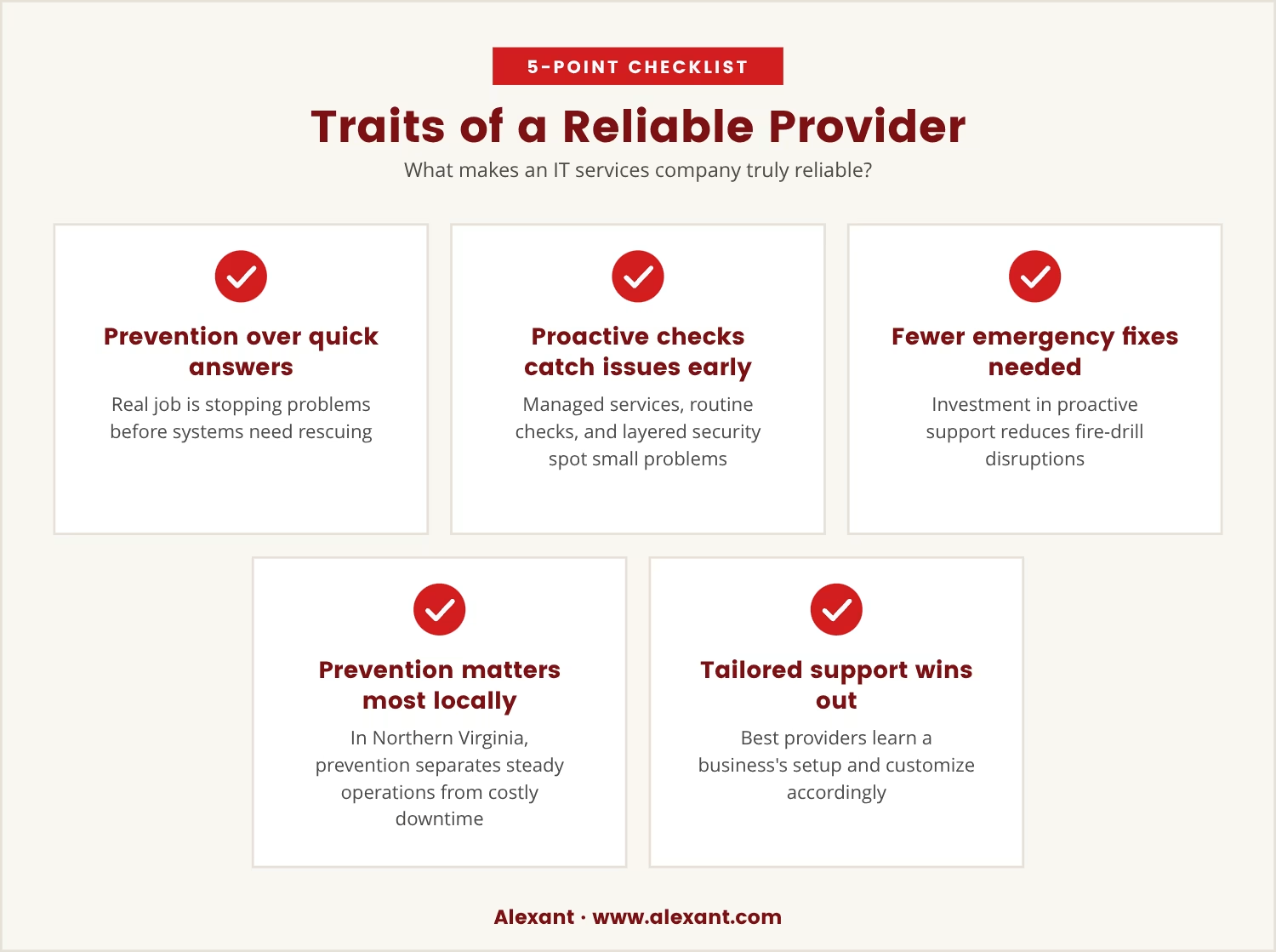
Reliability starts well before the phone rings. A dependable IT services company does more than answer calls quickly, because its real job is keeping problems from happening so systems stay up without needing a rescue.
That shows up concretely in managed IT services, routine system checks, and layered cybersecurity measures, all of which catch issues while they're still small and before they turn into emergency calls. A company that puts resources into this kind of proactive support is simply less likely to need the fire-drill fixes that eat into a client's week.
In Northern Virginia, where so many businesses depend on their technology to serve clients directly, that prevention isn't a nice extra — it's the difference between steady operations and costly downtime. A provider willing to learn a business's specific setup and tailor support around it is the one positioned to deliver that.
How proactive support changes the game
Proactive support flips the provider's job from waiting for failures to actively hunting for ways to strengthen the systems already in place. The distinctions below show what that looks like in practice.
Preventing downtime before it starts
A proactive provider monitors your network and devices continuously, catching small issues before they escalate. That ongoing watch is what keeps sudden outages rare instead of routine.
Regular updates and maintenance
Software and hardware get kept current as a matter of routine, which closes security gaps and improves performance without waiting for a visible problem to force the issue.
Strategic planning for growth
Beyond day-to-day upkeep, a forward-thinking IT company helps map out how your technology should scale, so growth doesn't outrun the systems meant to support it.
Strong cybersecurity focus
Layered security services work to block threats before they land, rather than cleaning up after an attack has already done its damage.
Transparent reporting
Clear reports on what's happening behind the scenes mean you're never guessing how your systems are actually performing.
Fewer emergency calls
The payoff of all this groundwork is fewer surprises, and more hours spent running the business instead of firefighting around it.
Signs a provider is focused on prevention, not just speed
Recognizing a prevention-minded provider comes down to a handful of concrete habits, visible well before anything goes wrong.
- Regular system reviews: Check-ins are scheduled to assess technology and flag improvements, not triggered only by a complaint.
- Tailored solutions: Services are built around the specific business, not dropped in as a generic package.
- Clear communication: What's being done, and why, is explained plainly rather than left opaque.
- Emphasis on uptime: The stated goal is keeping systems running, not just answering fast once they fail.
- Long-term partnerships: Conversations center on supporting growth, not only closing today's ticket.
Why your contract terms matter more than you think
Those habits are worth checking against the paperwork, because many businesses sign IT contracts on the promise of fast response only to find the actual terms guarantee nothing about prevention. Instead, the fine print can lock a company into exactly the reactive cycle described above.
That makes the agreement itself worth scrutinizing before signing. Does it specify proactive services like regular maintenance and security updates, or does it mainly spell out how quickly someone will call back?
A contract weighted toward prevention delivers more value over the life of the relationship, since it signals a provider invested in outcomes rather than ticket counts. That orientation is what ultimately shows up as steadier technology and fewer disruptions for the team depending on it.
Rethinking what matters most in IT support
All of this points to the same decision point: choosing an IT support company is a significant call, and while a fast response sounds appealing, it isn't the measure that protects a business day to day. What actually does the protecting is a provider working to keep problems from happening, not one that's simply quick once they do.
Anyone in Northern Virginia weighing a new IT partner might ask a simple question: is this company focused on keeping systems healthy, or just on being fast when they break? That answer tends to shape everything downstream, from daily operations to how well the business scales.

Rethink what you expect from your IT partner
Many businesses with 15 to 70 users find themselves stuck in support cycles that solve problems quickly but never stop them from happening. At Alexant, we know how frustrating it is to feel like you’re always waiting for the next issue.
We invite you to see how our approach focuses on prevention and reliability, not just speed. Let’s talk about what true IT partnership could look like for your business.
Ready to try prevention instead of just speed?
Test our approach risk-free for 90 days—no upfront or implementation fees, and you’ll get a full refund if you’re not satisfied.
Frequently asked questions
How can I tell if my IT support company is truly proactive?
A genuinely proactive provider schedules regular reviews of your systems, delivers clear reports, and flags improvements before issues surface, while also keeping technology updated and secure as routine practice rather than emergency response. If contact only happens after something breaks, that's a strong signal the provider isn't operating proactively.
What should I look for in a managed services provider contract?
Look for terms covering regular maintenance, security updates, and ongoing monitoring, spelled out clearly rather than implied. A strong managed services provider's contract explains how problems get prevented, not just how fast someone responds once they occur, so the agreement should visibly cover proactive work alongside emergency support.
Is a fast response time ever a bad thing?
Quick response is useful, but trouble starts when it becomes the only thing a provider promises, since that often signals prevention isn't the priority. The strongest IT support pairs fast help with real prevention, rather than treating speed as a substitute for it.
How does downtime affect small businesses?
Downtime interrupts daily operations, costs revenue directly, and can damage a business's reputation with its own clients; for smaller operations, even brief outages can carry outsized impact. A provider centered on uptime and prevention is the one positioned to keep those risks rare.
What are the benefits of tailored solutions from an IT company?
Tailored solutions fit the support to the business's actual needs instead of applying a one-size-fits-all package, which keeps the technology aligned with real goals and cuts down on recurring problems. Businesses looking for reliable, long-term results should prioritize providers offering this kind of customized support over standardized plans.